Hormuz Supply Risks Send Oil to One-Month High: What It Means for U.S. Investors and Mineral Owners
Oil reached a one-month high as renewed conflict raised Strait of Hormuz supply risks. This sourced analysis examines shipping exposure, insurance pressure, U.S. shale hedges, and the implications for mineral and royalty owners.
ANALYSIS / ANALYSIS
Hormuz Supply Risks Send Oil to One-Month High: What It Means for U.S. Investors and Mineral Owners
Oil reached a one-month high as renewed conflict raised Strait of Hormuz supply risks. This sourced analysis examines shipping exposure, insurance pressure, U.S. shale hedges, and the implications for mineral and royalty owners.
The Takeaway: On July 14, 2026, crude benchmarks reached a one-month high, with West Texas Intermediate (WTI) settling above $79 per barrel and Brent crude approaching $85 per barrel. [1] This price action was catalyzed by the collapse of the June 2026 U.S.-Iran ceasefire agreement, recurring maritime incidents in Omani territorial waters, and heightened supply disruption risks in the Strait of Hormuz. For accredited domestic energy investors, this escalation introduces a complex dynamic: while rising geopolitical risk premiums bolster near-term cash flow yields, they are simultaneously tempered by domestic operator hedging losses and broader macroeconomic headwinds.
Quick Answer
Oil reached a one-month high as renewed conflict raised Strait of Hormuz supply risks. This sourced analysis examines shipping exposure, insurance pressure, U.S. shale hedges, and the implications for mineral and royalty owners.
Fox Energy Insights provides objective, data-driven analysis for accredited investors. Our perspective is rooted in real-world energy infrastructure, operational reality, and direct asset ownership—free from Wall Street hype.
Table of Contents
- 1. The July 2026 Geopolitical Catalyst & Market Response
- 2. The Strait of Hormuz: Global Energy's Primary Chokepoint
- 3. Shipping Logistics, AWRP Surcharges, and the DFC Facility
- 4. The Bypass Mirage: Pipeline Limits & Inelastic Qatari LNG
- 5. Practical Implications for U.S. Shale, Investors, and Royalty Owners
1. The July 2026 Geopolitical Catalyst & Market Response
The sudden reversal in crude price momentum culminates a volatile multi-week period in the Middle East. The primary market catalyst was the definitive collapse of the June 2026 U.S.-Iran Memorandum of Understanding (MOU) ceasefire. This diplomatic breakdown was immediately followed by a series of localized drone and missile attacks targeting commercial vessels transiting the Strait of Hormuz and nearby waters. [2]
Adding to the structural volatility was a short-lived policy proposal from the Trump administration to levy a 20% transit cargo fee on commercial vessels utilizing Omani territorial waters, intended to offset the cost of heightened U.S. naval security escorts. While this proposal was quickly withdrawn following regional and legal pushback, the proposal was withdrawn the following day and replaced with proposed Gulf investment commitments. [3]
As risks to the Strait of Hormuz intensified, commodity trading advisors (CTAs) and systemic money managers were caught heavily short. The subsequent wave of aggressive short covering amplified the upward price movement, pushing WTI futures to their highest level in over thirty days. However, despite the sharpness of the move, physical crude flows have not yet suffered a major, sustained interruption—distinguishing this price spike as a classical expansion of the geopolitical risk premium rather than a structural supply deficit.
2. The Strait of Hormuz: Global Energy's Primary Chokepoint
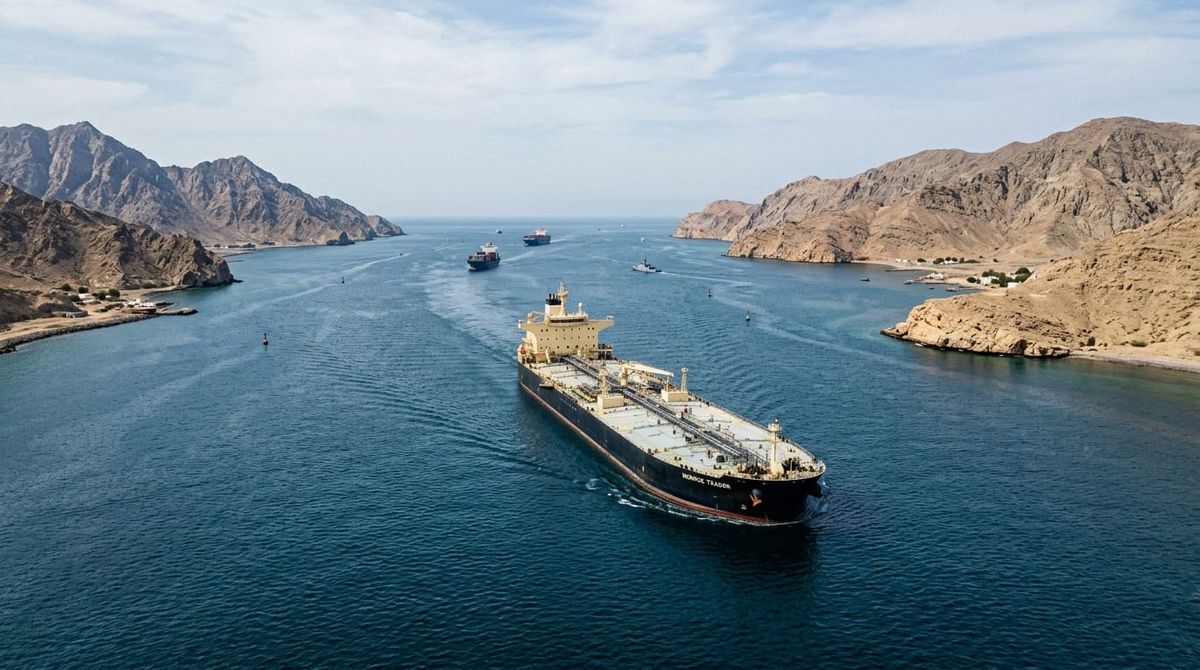
To understand the gravity of the current threat, one must examine the physical and logistical reality of the Strait of Hormuz. Measuring just 33 kilometers (21 miles) wide at its narrowest point, the shipping channel relies on a strict Traffic Separation Scheme (TSS) consisting of two-mile-wide inbound and outbound lanes separated by a two-mile-wide buffer zone. Virtually all deep-draft transit occurs within Omani and Iranian territorial waters.
This narrow passage is the single most critical chokepoint in the global energy economy. It handles approximately 20 million barrels per day (bpd) of liquid fuels—representing nearly 25% of all seaborne global oil trade. Furthermore, it serves as the exclusive maritime exit route for roughly 20% of the world’s liquefied natural gas (LNG), primarily sourced from Qatar. [4] [5]
| Resource / Metric | Daily / Annual Volume | % of Global Seaborne Trade | Primary Export Destination |
|---|---|---|---|
| Crude & Refined Liquids | ~20.0 Million bpd | ~25% | Asia-Pacific (China, India, Japan) |
| Liquefied Natural Gas (LNG) | ~80–85 Million tons/year | ~20% | Asia-Pacific & Western Europe |
A crucial detail for U.S. investors is the geographical destination of these flows. Approximately 80% to 85% of the crude transiting the Strait is destined for Asian economies, including China, India, Japan, and South Korea. Consequently, while a disruption would trigger a global price shock, the direct physical supply deprivation would fall most heavily on Asian refiners, forcing them to bid aggressively for alternative Atlantic Basin cargoes.
3. Shipping Logistics, AWRP Surcharges, and the DFC Facility
The threat of escalation in the Strait manifests rapidly in maritime logistics and financial underwriting long before physical barrels are lost. For a Very Large Crude Carrier (VLCC) capable of carrying 2 million barrels of crude, the economics of transit are governed by freight rates and insurance premiums.
Under normal operating conditions, marine insurers charge a baseline War Risk Premium. However, when active hostilities occur near the shipping lanes, underwriters declare the region a listed area, imposing an Additional War Risk Premium (AWRP). During the current disruption, reported AWRPs have risen from roughly 0.15% of a vessel’s value before the conflict to about 5% for some Gulf transits. For a modern VLCC valued at $120 million, a 5% AWRP translates to an additional $6 million in insurance costs per voyage, forcing immediate freight-rate adjustments and altering voyage economics. [6]
To mitigate this systemic risk and stabilize the shipping lanes, the U.S. International Development Finance Corporation (DFC), in partnership with domestic commercial underwriters, has structured a $40 billion political risk reinsurance facility. This specialized facility acts as a federal backstop, providing secondary reinsurance to commercial vessels carrying non-sanctioned energy cargoes. This policy mechanism helps prevent a total freeze in maritime trade by ensuring that private tankers can secure adequate liability coverage when private capacity contracts. [7]
The Threat of Force Majeure
If physical access to the shipping lanes is compromised, state-owned entities such as QatarEnergy, Saudi Aramco, and ADNOC would likely declare force majeure on specific supply contracts. This legal declaration temporarily releases operators from liability for non-delivery due to circumstances beyond their control, immediately scrambling international logistics and forcing global buyers to source alternative spot cargoes from the North Sea, West Africa, and the U.S. Gulf Coast.
4. The Bypass Mirage: Pipeline Limits & Inelastic Qatari LNG
A common misconception in mainstream financial media is that land-based pipelines can easily bypass a disrupted Strait of Hormuz. While bypass infrastructure does exist, its realistic utility is highly constrained.
Saudi Arabia operates the East-West (Petroline) Pipeline, stretching from its eastern oil fields to the Red Sea port of Yanbu. The UAE utilizes the Habshan-Fujairah pipeline to transport crude directly to the Gulf of Oman, bypassing the Strait entirely. However, a significant gap exists between the nominal (designed) capacity of these systems and their actual, effective operational capacity.
- Saudi East-West Pipeline: While boasting a nominal capacity of approximately 5.0 million bpd, its effective sustained throughput is closer to 3.0 million bpd due to pump-station limitations, domestic power generation demands, and terminal bottlenecks at Yanbu.
- Habshan-Fujairah Pipeline: This system has a nominal capacity of 1.5 million bpd, but downstream loading facilities and blending constraints have historically limited effective sustained flow to 1.0 million bpd.
Cumulatively, even under maximum emergency operations, these pipelines can only bypass approximately 4.0 to 5.0 million bpd—leaving over 15 million bpd of regional liquid exports entirely stranded.
Furthermore, the infrastructure gap is absolute when it comes to natural gas. Unlike crude oil, which can be rerouted overland, Qatari LNG has zero pipeline bypass alternatives to reach international markets. The liquefaction facilities at Ras Laffan depend entirely on specialized LNG carrier transits through the Strait of Hormuz. A prolonged blockade or suspension of safe passage would instantly remove 20% of global LNG supply from the market, generating an inelastic pricing squeeze that would reverberate through European and Asian natural gas hubs far more severely than the crude market shock.
5. Practical Implications for U.S. Shale, Investors, and Royalty Owners
For accredited investors evaluating domestic opportunities, the geopolitical premium in Brent and WTI futures requires careful tactical interpretation. The domestic impact is highly segmented across operators, equity investors, and mineral and royalty owners.
The Double-Edge of Hedging for U.S. E&Ps
While a rising WTI price is directionally positive for domestic producers, the near-term cash flow benefit is not distributed equally. U.S. shale operators commonly use instruments such as fixed-price swaps and collars to protect capital programs. The degree to which any producer benefits from the current price move depends on the volumes, prices, and duration disclosed in its current hedge book.
When WTI trades above contracted hedge prices, a heavily hedged operator may not capture the full upside on covered volumes. Derivative accounting can also create gains or losses that differ from operating cash flow. Investors should therefore review each exploration and production company’s current filings, realized pricing, and hedge schedule rather than infer exposure from the benchmark alone.
U.S. Mineral and Royalty Owners
Unlike operating companies that carry heavy debt loads, equipment liabilities, and restrictive hedging books, private mineral and royalty owners occupy a highly advantageous position. Royalty interest owners receive a direct percentage of gross production revenue free of operational expenses.
Consequently, when WTI benchmarks rise, mineral owners may see higher realized revenue flow through royalty payments, subject to lease terms, commodity differentials, deductions, and normal payment lags. However, this immediate cash flow yield must be balanced against broader operator behavior. If global price volatility is accompanied by rising macroeconomic headwinds and high capital costs, conservative Permian Basin and Bakken operators may choose to hold capex flat rather than accelerating their drilling schedules. In this scenario, royalty owners benefit from higher price realization on existing production, but should not assume a rapid acceleration in new well completions.
Strategic Outlook
The current one-month high in crude prices serves as a stark reminder of the fragile nature of global energy supply chains. As long as the Strait of Hormuz remains vulnerable to geopolitical friction, the premium embedded in global benchmarks will persist. For domestic investors, the path forward lies in identifying high-quality, low-debt assets—specifically direct mineral and royalty interests in premier basins like the Permian—that can harvest this structural volatility without exposing capital to the operational and hedging bottlenecks of the public E&P sector.
Sources and References
- Rigzone: Oil Hits One-Month High, July 14, 2026.
- Associated Press: U.S. restores blockade after attacks on Hormuz shipping, July 14, 2026.
- Axios: Trump withdraws proposed 20% Hormuz transit charge, July 14, 2026.
- U.S. EIA: World Oil Transit Chokepoints.
- U.S. EIA: About one-fifth of global LNG trade flows through Hormuz.
- The National: Hormuz shipping and war-risk insurance disruption, July 12, 2026.
- U.S. DFC: Up to $40 billion in maritime reinsurance coverage.
Navigate Geopolitical Volatility with Direct Energy Assets
Global shipping chokepoints are increasingly vulnerable, but domestic energy security remains paramount. At Fox Energy, we specialize in helping accredited investors acquire high-yield, direct mineral and royalty interests in the core of the Permian Basin—providing commodity-price exposure without directly bearing drilling and operating costs, while remaining subject to production, price, title, counterparty, and concentration risks.
Contact Our Investment Team Today
Key Takeaways
- +1. The July 2026 Geopolitical Catalyst & Market Response
- +2. The Strait of Hormuz: Global Energy's Primary Chokepoint
- +3. Shipping Logistics, AWRP Surcharges, and the DFC Facility
Trust & Review
- Author: Jason Gilbert
- Reviewer: Founder & CEO
- Last updated: 7/14/2026
- Workflow: rss
Sources
Related Coverage
- Brent Jumps on Renewed Iran Clash: Markets Brace for $100+ Crude
- Why Oil Prices Just Fell Below $100: Analysts Weigh In on the Iran Deal and OPEC’s Fracture
- Oil Prices Today: Strait of Hormuz Standoff Triggers Market Volatility
- Qatar Quietly Ships LNG via Hormuz to Key Buyers
Fox Energy
Continue building authority from the same site hub.